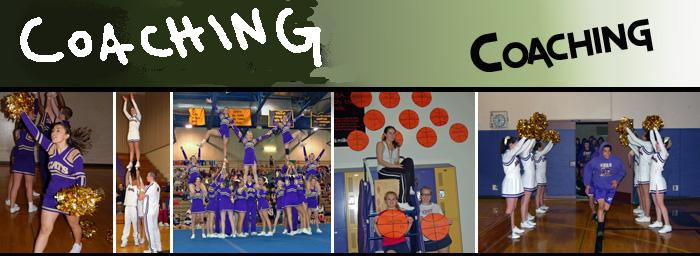
Coaching cheerleading is not an easy job. Unfortunately, unlike other jobs, you actually have to have had experience in the feild to be a good coach. A good coach has to deal with so many things, organizing, peace making, competitions,tryouts, communication with the athletes, and so much more...
Articles
Keeping busy during off-season The competition season is wrapping up, but as any cheerleader or cheerleading coach knows - there's never really an off season in cheerleading. We've put together our list of things to do during the off season to help prepare for your next cheer season. Whether you're a coach or a cheerleader, be sure to check out this list! Coaches: 1) Create a Calendar of Events. Outline the entire year of events to help keep yourself and your cheerleaders organized. Key events that should be on your calendar: Cheerleading Tryouts 2) Gather all necessary Paperwork and Forms for the year. Make a categorized list of any paperwork that will be needed for tryouts, camps, competitions and etc... Example forms include: Letter to Parents 3) Set Goals. Set goals and expectations for yourself and your cheerleaders. 4) Prep Your Cheerleading Supplies Order. Just because your squad isn't established doesn't mean you can't determine what you will be ordering once the squad is chosen. Most cheerleading catalogs are mailed between February 15th and March 15th. Research each catalog and select the cheerleading shoes, cheerleading uniforms and accessories and any props that you will be ordering. Don't forget to take a look at the Cheerleading Uniform Creator to fully design your uniform. You can select your school colors, striping and, best of all, lettering. You'll know exactly what your uniform will look like before you order! Don't forget about cheer camp. You can select the cheerleading camp outfits also. Choose the t-shirts and shorts that each cheerleader will need for summer camps. If you can complete your selections before your squad is chosen you'll be one step ahead in ordering. We all know that productions times for uniforms can range from 4-10 weeks for custom cheerleading merchandise. Getting your order in early will guarantee it before your season starts. And don't forget to watch for early bird specials. Most Cheerleading Catalogs will offer discounts to coaches who get their team orders in early! Be sure you're on the email list to receive the special offers. Cheerleaders: You're not just a cheerleader part of the year - you're a cheerleader the entire year. During the off season you should be thinking about the upcoming season. 1) Stay Involved. Mentor youth recreation leagues or work with your coach and other team members to host a cheerleading camp. 2) Stay Fit. Keep in shape while you're not cheering. Work on your strength and flexibility. Stretch while doing homework. 3) Set Goals. Keep a notebook with a list of your goals and progress so you can see for yourself that you truly are making progress. Give yourself something to work toward for the upcoming season. 4) Keep In Touch. Keep in touch with your teammates and coaches. It's important to keep that bond even in the off season. Work with your teammates and coaches to create your list of goals and expectations. Together you can keep each other motivated.
First-year Coaches: A Guide to a Successful SeasonBy Kristen Mundahl Coaching – regardless of the age group, sport, or level of competition – remains a very difficult task. The most important aspect for coaches to keep in mind throughout their first year and beyond is the reasons one has chosen to coach to begin with. Coaches will undoubtedly encounter very difficult and trying times within their first year; however, reminding one’s self of the wonders of the role they have selected will allow for a smoother year all around. Personally, I decided to coach dance team for a few reasons. Firstly, I maintain a passion for both the art and sport of dance. In addition, I feel blessed to witness the progress an individual, but more importantly a team is able to experience within a mere season or two. Lastly, dance team promotes unity both on and off the floor. A team cannot experience success performing or competing if solid relationships fail to exist naturally on a day to day basis. I believe that many coaches choose to take part in this experience for at least one of the reasons mentioned above. Change is a difficult and often uncomfortable encounter for several people. Therefore, coaches as well as team members need to remain flexible and open-minded about and throughout their upcoming year. Progress derives from change and dance team continuously advances in its level of difficulty, creativity, and performance. As a result, change remains an imperative piece to success and enduring competitiveness within a team’s given region. No two coaches ever approach their role in the same manner because every coach teaches in a distinctly unique fashion. Each coach will approach technique, instruction, issues, roles, and concerns very differently. What every team member needs to understand is that change can and usually is a wonderful experience and must take place to experience success with that particular coach. Equally, a new coach needs to understand that they are entering a previously established team and must not make changes too quickly or drastically. As a coach, make changes where you deem necessary, yet try to continue with the things that were working well for your team as well. Your dancers will appreciate this immensely and will respect you more as a result. Although, your role and expectations as a coach remain very clear, your dancers often strive to fill their uncertain role as a team member. Each individual yearns to feel a significant part of the team and as though the team needs them at all times. Provide little opportunities for individual dancers such as leading stretches, creating a poster, or selecting a quotation to read to the team. These small, yet considerable opportunities will unite your team in ways you never expected. Let each member know that the team can only function as such. Help them to recognize and appreciate the commitment they have made by choosing to be a member of your team because it truly is a choice. If even one member fails to uphold their role through dedication, desire, and hard-work, then the team will not succeed. The final words I would like to leave with new coaches are that although much success can be measured from winning, trophies, and medals, the true success of a team cannot be measured at all. It comes from the little victories and accomplishments that occur each day: a higher leap, a brighter smile, pointed toes, a new friendship. Give criticism, yet always in a positive manner, motivate, lead, inform your team of when they are doing well, not simply poorly, and above all, make time for fun and laughter each and every day. ***Below you will find a succinct outline of items that are essential to accomplish throughout any given year coaching a dance team. Although, this list is not entirely inclusive and may vary greatly from program to program, I hope it establishes a solid reference for you to use. Spring/Summer: Fall: Winter:
COACHES/CAPTAINS LETS GET ORGANIZED (This is an article from the coaching tips book -“Reach For The Stars”. For more information contact Angela Lund of S.T.A.R.S. Leadership Training)COACHES: Coaches should work to improve themselves every year. Look at your previous year and analyze what worked and what did not. Then make a plan to keep what worked and change what didn’t. Now you have a workable plan set in motion…here’s how to get started! START WITH GREAT TRYOUTS: Have a good judging staff in place and keep all forms in case you are challenged with questions from parents. Pick strong leaders/captains. HOLD SEVERAL MEETINGS OFF HAND TO GET THE BALL ROLLING: NOW SET GOALS FOR YOUR SEASON: Then make a list of goals that corresponds with teaching these elements to the dancers. Make a time line for the goals. Get a calendar and mark the calendar with dates of wished completion of those goals. Plan how you will work to achieve the goals. What intermediate steps you must take to reach them. Now…Go back to the calendar and mark the dates for little milestones. DURING SEASON: Have a detailed lesson plan for each practice. Keep motivation high and reward often. STAY ON TOP OF THINGS: Revise plan as needed. DOCUMENT EVERYTHING: CAPTAINS: It is an honor to be chosen to be a leader of your team. You must take it seriously! Look and see how you can be the best captain possible! LOOK BACK ON LAST YEAR: SET GOALS: Then make a list of goals that corresponds with getting these elements to the dancers. Make a time line for the goals. Get a calendar and mark the calendar with dates of wished completion of those goals. Plan how you will work to achieve the goals. What intermediate steps you must take to reach them. Now…Go back to the calendar and mark the dates for little milestones. COMMUNICATE WITH YOUR COACH REGULARLY: Help with suggestions on how to improve motivation. Ask for ideas on warm ups and technique that the coach wants you to incorporate into skill time. Be the coaches sidekick…support her all the time, even behind the scenes. If you do not agree with her, talk to her about it privately. Never undermine her authority or the rest of the team will loose respect for both her and you. MOST IMPORTANTLY…Keep things confidential! LOOK FOR IDEAS ON MOTIVATION: Bring a quote everyday to practice and LIVE IT! Find a cheer to pep everyone up. Look for games that will create team bonding. Leave any negativity away from practice. KEEP A BOOK ON TEAM “STUFF” KEEP THINGS POSITVE BEHIND THE SCENES: Say hello to everyone. Include those rookies! Become a role model coachby Katey Rock, Director CheerRock All-Stars-Ventura County, CA. We all have the shirts that say “Coaches make dreams come true” or “I coach because I care”. We all have them because its true. And though we may be tough at practice and even show our frustration at competition, deep down, we would not even bother if we didn't love taking that team or individual and showing them what they could become. The true reward is helping a cheerleader accomplish a level of skill that even she didn’t think possible. There is no “right” way to coach. There are as many different styles of coaching as there are coaches. Some never smile and some are too nice. But if you want gage where you fit in the mix, ask yourself in every action you take and every order you shout “am I doing this with respect?” The key in all we do is RESPECT. No matter how difficult the team or the tension between this group and that click, you will give those young people a life lesson they’ll never forget because it applies always. If you can show respect in everything you do, you can’t go wrong. If you’re having trouble with your team, do a “respect” test Respect can be hard. Teaching respect can be even harder. You have to start with being the example. Let your team know up front that you will give them complete respect, but you expect nothing less in return. If they respect their commitment to the team, they will arrive to practice on time, with the right shoes and attitude. When they need to be reminded of their commitment, you simply enforce their decision. If they decide to arrive late or not prepared for practice, you must respect their decision by allowing them the consequences. It is actually disrespectful not to award the punishment. If you let one girl slide on the rules, she (and the rest of the team) gets a mixed message. Now the rules are blurred. Naturally, someone else will try this and eventually you will enforce the rule, but at what point…after you get frustrated at the lack of respect? It goes both ways. When conflict does arise within a group, respect the feelings of the team members by allowing them the chance to work it out. Now this can easily get out of hand, so remember, you’re the adult and ultimately have the final say. They need your guidance. In the end, be the example. Show respect toward other coaches and parents, but most of all show respect toward the individuals that look up to you everyday.
|